
Ask ten people how many ads you need to scale and nine will say “more.” That is true and it is worthless. Nobody tells you how many more, or how they arrived at the figure. Every guide points at meta ad volume, then stops short of the number. A number does exist, and it comes out of your own account rather than a blog post. Below are the benchmark counts by spend tier, what changes between $100k and $500k, and the math to calculate your own figure.
TL;DR
- Volume is the lever, not targeting. Meta reads your creative first and finds the audience second, so creative variety now does the job targeting used to do.
- Most brands making this jump need three to four times their current output. Average accounts at $200k to $1m a month launch about 11 ads a week. Top accounts on the same budget launch around 31.
- Winners are rare on purpose. Only 5 to 8 percent of ads become real performers, which works out at roughly one winner for every twenty you launch.
- Structure decides whether you can read the results. Three to six ads per ad set, ad sets grouped by concept, three to five campaigns in total.
Why the Number of Ads Per Ad Set Actually Matters
Your ad count is not a style choice. It decides whether your test data is useful or noise.
Meta does not split budget evenly across an ad set. It runs a live auction and pushes spend toward whatever shows early promise. Around half of all ads end up with little or no spend at all.
That concentration is fine with a few strong ads competing. It breaks the moment you overload the ad set. The system picks two winners fast, and the rest sit starved.
Running one ad per ad set fails for the opposite reason:
- One ad cannot sequence, so the same person sees the same thing every time.
- Fatigue arrives sooner, and cost per acquisition climbs with it.
- You have nothing to compare against, so you learn nothing about the creative.
Three to six ads per ad set is the working range for testing. Push higher only when the daily budget can fund each one properly.
How Many Ads Do You Actually Need?
More than you make now, and the number rises with spend. Here is what accounts at every tier actually launch.
Motion’s 2026 Creative Benchmarks report studied more than 550,000 Meta ads, roughly $1.3 billion in spend, across over 6,000 advertisers.
| Monthly ad spend | New ads per week (average) | New ads per week (top 25%) | Winners per month (average) |
| Under $10k | 2.8 | 4.8 | ~0 |
| $10k to $50k | 4.1 | 8.1 | 0.25 |
| $50k to $200k | 6.7 | 16.0 | 0.75 |
| $200k to $1m | 11.2 | 31.1 | 1.75 |
| $1m and above | 18.9 | 54.6 | 4.0 |
Two things stand out.
First, winners are rare. Only around 5 to 8 percent of ads become real performers. That is about one winner for every twenty you launch.
Second, meta ad volume is a choice rather than a budget. At the $200k to $1m tier, the average account ships 11 ads a week and finds 1.75 winners a month. Top accounts ship about 31 and find 5.99.
Same spend. Three times the volume. Three times the winners.
Why Does Scaling Now Take More Ads Than It Used To?
For a decade, media buying was an audience game. You built lookalikes, layered interests and guarded your targeting like a recipe. That era is over. Meta reads your creative first and finds the audience for it second.
Different creative reaches different people. So creative variety is your targeting now.
The win rate does the rest of the work. You cannot pick winners in advance, and most ads never get real spend, so you find them by taking more shots. Budget alone will not do it. This is why creative strategy is the biggest lever for scale.
What Changes on the Climb From $100k to $500k
You cross two tiers on this jump, and what you should do changes at each one.
At $50k to $200k a month, creative becomes the main growth lever.
- Average accounts ship around seven new ads a week. Strong ones ship sixteen.
- Roughly half your output should be iterations of angles that already work.
At $200k to $1m a month, stop counting single ads and start budgeting testing as a share of spend.
- A brand at $250k putting 40 percent into testing needs about fifty new ads a month.
- Split that roughly fifteen fresh concepts to thirty-five iterations.
Format mix is what makes those counts affordable. Creator video costs a few hundred dollars per asset. A designed static built on existing product photos costs a fraction of that. Our roadmap from $100k to $1m in monthly spend covers the full climb.
How Many Ad Sets and Campaigns Do You Need to Run That Volume?
Fewer than you think. Two to four ad sets per campaign is the working range, and most brands need three to five campaigns in total.
Split your budget across ten small audiences and none of them gathers enough data. Group ad sets by concept instead.
That split gives you two readable layers:
- Concepts compete at the ad set level. You see which angle the market actually wants.
- Executions compete at the ad level. You see which version of that angle works best.
A clean facebook campaign structure separates by intent, never by age or gender. One scaling campaign takes most of the budget. One retargeting campaign takes a smaller share. One testing campaign takes the rest.
Name every ad set by persona, angle, offer and launch date. It sounds like admin. It is what lets you read concept performance later without digging through the interface.
Why Most Brands Cannot Hit These Numbers
The volume has to come with a standard. Diversity has to be real. Three color swaps of one static count as one idea. A founder story, a testimonial and a side-by-side count as three. Your ad creative strategy should produce new angles, not new edits.
Keep your creative testing methods clean as well:
- A concept test asks whether an angle works at all.
- A variation test asks which version of a proven angle wins.
- Blend the two in one launch and you cannot read either result.
Then gate the work. A written script standard before production, and a fixed review checklist before delivery, are what hold quality while output triples. That is how we build 50 ad concepts per brand per month. In house or with a performance creative agency, the rule holds. Output without a standard just produces losers faster.
How to Work Out Your Own Number
Creative demand is the number of new ads your account needs each month to hold efficiency at your target spend.
The tiers above are a mirror, not a quota. One brand at $500k may need 300 ads. Another at the same spend may need twice that, because its ads decay faster.
Here is the math you can run today:
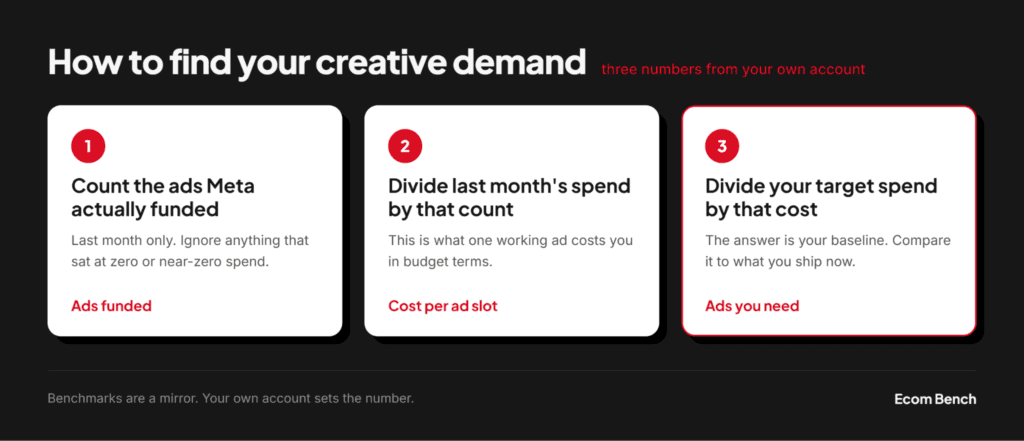
Then sense-check that baseline against how your ads behave. Watch your zero spend rate, how much budget sits in your top five ads, and whether return on ad spend holds up after launch week. Most tools to evaluate creative performance already report these ad creative performance metrics. Our 90-day creative velocity system turns the figure into a weekly pace.
The Bottom Line
The right meta ad volume is not an opinion. It comes out of your own account. Count the ads that got real spend last month, divide your spend by that number, then divide your target spend by the result. Compare the answer to your tier, then build the pipeline that reaches it.
About Ecom Bench
Ecom Bench is a DTC performance creative agency. We build repeatable creative systems instead of one-off ads. The work covers creative strategy and messaging, weekly test-ready ad concepts, and testing, analysis and iteration. We have supported 150+ brands, $100M+ in ad spend and $250M+ in revenue impact.
If you want a clear read on your own creative demand, you can book a discovery call with our team.